How a Small Japanese Fishing Region Quietly Rewired America's Appetite for Premium Seafood
In the spring of 2021, a sushi chef in Portland, Oregon named Kenji Watanabe made a decision that seemed, at the time, like a modest operational adjustment. His usual West Coast seafood distributor was struggling with pandemic-era supply chain disruptions, and a contact in Japan's seafood export industry had been nudging him for months to try fish sourced directly from Nagasaki Prefecture. He agreed, placed a small trial order, and waited.
What arrived changed his restaurant.
"The quality was on a completely different level," Watanabe recalls. "I'm not being dramatic. My regulars noticed immediately. They were asking what was different. I had to explain where Nagasaki even was."
Watanabe's experience was not unique. Across the country—in New York, San Francisco, Seattle, Miami, and Chicago—a small but growing number of high-end seafood restaurants and omakase counters were quietly beginning to draw from the same source: a regional fishing economy on Japan's southwestern island of Kyushu that had, largely outside of American culinary awareness, been undergoing a significant transformation.
The Pandemic Disruption That Became an Opportunity
To understand how Nagasaki seafood found its way into the American premium dining conversation, you have to understand what happened to Japan's domestic seafood market between 2020 and 2022.
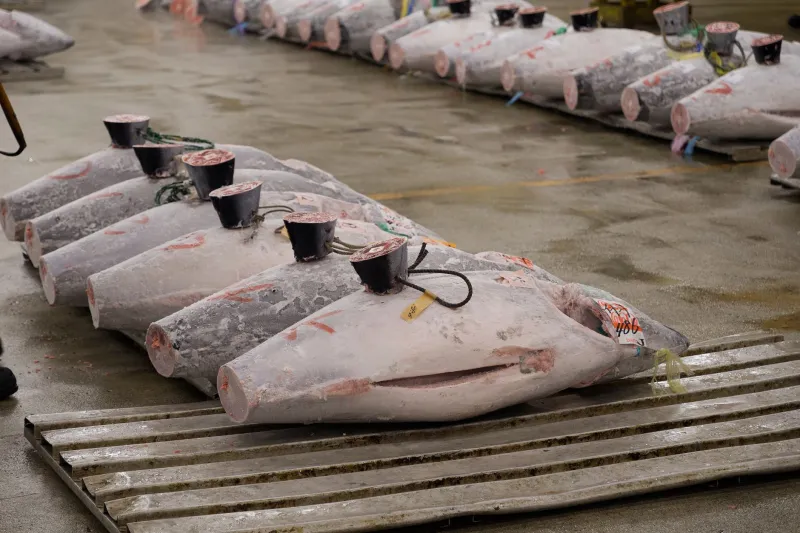
The closure of Japan's restaurant industry during successive pandemic lockdowns created a massive domestic demand vacuum. Fish that would normally have been absorbed by Tokyo's Tsukiji and Toyosu markets, high-end ryokan kitchens, and urban sushi restaurants suddenly had nowhere to go at profitable prices. Nagasaki's fishing cooperatives, which had long operated with a primarily domestic focus, faced a stark choice: reduce catch, absorb losses, or find new markets.
Some cooperatives began investing seriously in export infrastructure—cold chain logistics, IQF (individual quick-freeze) technology, and English-language marketing materials aimed at US and European buyers. Organizations like the Nagasaki Prefectural Federation of Fisheries Cooperative Associations began actively facilitating introductions between local fishing operations and foreign importers.
"It was painful to watch initially," says Hiroshi Tanaka, a fisheries consultant based in Nagasaki City who helped broker several early export relationships. "But the cooperatives that moved quickly on export found that their product was genuinely competitive at a global level. The quality was already there. The infrastructure just needed to catch up."
The Importers Who Built the Bridge
On the American side of this equation, a handful of specialty seafood importers recognized what was becoming available and moved to establish direct sourcing relationships with Nagasaki fishing cooperatives.
True World Foods, one of the largest Japanese seafood distributors in the US, expanded its Nagasaki sourcing during this period. Smaller boutique importers—many operating out of California and the Pacific Northwest—also began establishing direct relationships, sometimes flying to Nagasaki to visit fishing operations and processing facilities in person.
"The due diligence process was extensive," explains Rachel Kim, who runs a specialty Japanese seafood import business out of Los Angeles. "We're talking about cold chain verification at every step, documentation of catch methods, traceability back to the specific vessel in some cases. American buyers at the premium level want that story, and they want it to be verifiable."
Kim began importing Nagasaki-sourced sea bream, yellowtail, and mackerel in 2021, and says her restaurant client list grew significantly in 2022 and 2023 as word spread through chef networks. "Chefs talk. Once two or three high-profile kitchens started using the product and talking about it, the inquiries started coming in fast."
Logistical Innovation Made It Possible
One of the less-glamorous but genuinely critical factors in Nagasaki seafood's American reach is the technological improvement in how fish is frozen and transported. Traditional freezing methods damage cellular structure, resulting in product that loses moisture and texture when thawed. The IQF technology now widely used by Nagasaki processing facilities freezes fish so rapidly that ice crystal formation is minimized, preserving the fish at a cellular level in ways that were not reliably achievable a decade ago.
The practical result is that a sea bream caught off the Goto Islands can arrive at a restaurant in Denver, Colorado in a state that a chef can legitimately serve as high-quality sashimi. That was not a realistic proposition for most of the history of international seafood trade.
Air freight logistics also improved meaningfully during the pandemic period, somewhat counterintuitively. With passenger flight volumes down, cargo-only routes became more economical for perishable goods, and several Japanese seafood exporters locked in favorable long-term freight agreements that have continued to benefit the supply chain.
What Changed in American Dining Rooms
The downstream effects of this supply chain shift are visible, if you know where to look.
In cities with strong Japanese culinary communities—Los Angeles, New York, San Francisco, Honolulu—the number of omakase restaurants offering explicitly regional Japanese fish sourcing has grown substantially. Nagasaki, alongside other prominent Japanese fishing regions like Hokkaido and Toyama, now appears on menus in a way that would have been unusual five years ago.
But the influence has also spread beyond strictly Japanese dining contexts. Progressive American seafood restaurants, influenced by the quality standards these imports established, have begun applying similar scrutiny to their domestic sourcing. The question "where exactly is this from, and how was it handled?" has become more common in purchasing conversations across the industry.
"Nagasaki raised the bar," says Marcus Chen, a seafood buyer for a restaurant group operating in New York and Boston. "Not intentionally—they were just trying to survive a market disruption. But the quality they were offering made everyone in the supply chain more thoughtful about what premium actually means."
The Cultural Dimension
There's a human element to this story that supply chain logistics don't fully capture. The fishing families and cooperative members in Nagasaki who pivoted toward export during the pandemic years were not simply executing a business strategy. Many were protecting livelihoods and traditions that had sustained their communities for generations.
The Goto Islands, a remote archipelago west of Nagasaki's main peninsula, are home to fishing communities that have operated in relative isolation for centuries. Their methods for handling and processing fish reflect accumulated generational knowledge that has no direct equivalent in Western seafood culture. When that knowledge reaches an American restaurant table—embedded invisibly in the quality of the product—something genuinely meaningful has traveled across an ocean.
"I think about that sometimes when I'm breaking down a fish from there," says Kenji Watanabe, the Portland chef whose story opened this piece. "There's a whole world behind this thing. A whole set of people who cared about it before I ever touched it."
That kind of provenance, once experienced, is hard to give up. Which is probably why the chefs who discovered Nagasaki seafood during those turbulent pandemic years are still sourcing it today—and why their diners keep coming back.
At Nagasaki Sakana, this is exactly the kind of story we exist to tell. The fish on your plate has a history. More often than you might expect, that history begins on a small boat off the coast of Kyushu.