The Secret Ingredient Your Kitchen Is Missing: Nagasaki's Ancient Art of Fish Fermentation
There's a moment — if you've ever added a splash of a really good fish sauce to a braise, or crumbled dried squid over a bowl of ramen — where something clicks. The dish doesn't taste fishier. It tastes deeper. More itself. Like someone turned up a dial you didn't even know existed.
That sensation has a name: umami. And if you want to trace it back to its roots, you'd do well to start in Nagasaki.
Salt, Time, and the Kyushu Coast
Nagasaki has always had a complicated, intimate relationship with the sea. Perched on the western edge of Kyushu, it was Japan's gateway to the outside world for centuries — a port where ideas, ingredients, and techniques crossed borders long before globalization was a concept. The region's fishing culture runs deep, shaped by cold, nutrient-rich currents that funnel some of Japan's most prized seafood through its waters.
But here's the thing about fishing communities: they've always had to deal with surplus. Before refrigeration, that meant preservation. And preservation, done right, means fermentation.
Fish fermentation in Japan isn't one single thing. It's a whole family of techniques, each with its own regional personality. Nagasaki's contribution to this tradition is significant — from sakiika, the hand-pulled dried squid that's been snacked on and cooked with for generations, to fermented fish pastes and aged fish sauces that bear a strong family resemblance to Southeast Asian condiments like Vietnam's nước chấm or Thailand's nam pla.
The most celebrated of these is shottsuru, a Japanese fish sauce with a flavor profile that's simultaneously familiar and startling. Less sharp than a standard Thai fish sauce, it carries a rounder, almost savory sweetness — the kind of thing that makes you stop mid-bite and wonder what you're tasting.
What the Artisans Know
Spend any time talking to the people who actually make these products in Nagasaki, and a few things become clear pretty quickly.
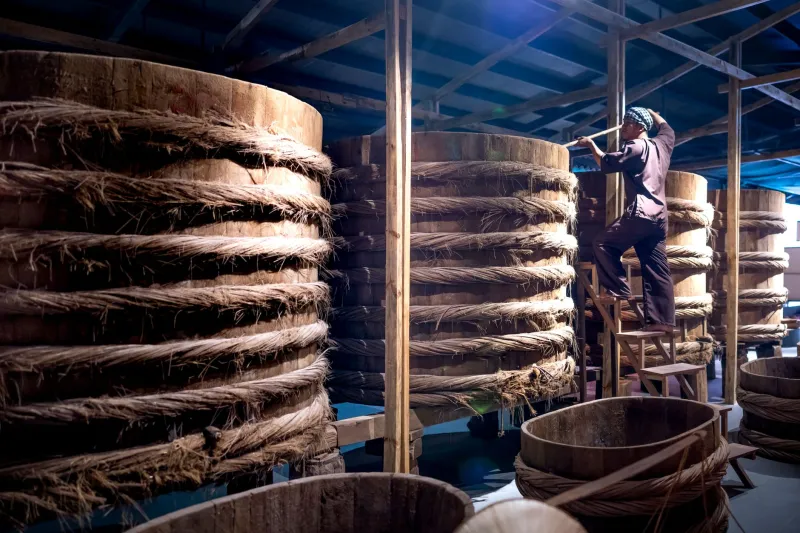
First: patience is non-negotiable. Traditional shottsuru is made by packing fish — often hatahata (sandfish) or mackerel — in salt and leaving it to ferment for anywhere from one to three years. The salt draws out moisture, creating a brine that slowly transforms through microbial activity into something extraordinarily complex. You can't rush it. Attempts to shortcut the process produce something technically similar but culinarily flat.
Second: the fish matters enormously. Nagasaki artisans are specific about sourcing — the freshness of the catch at the moment of salting, the fat content of the fish, even the season in which it's harvested all influence the final flavor. This isn't artisanal snobbery. It's chemistry.
Third: these products are tools, not garnishes. A Nagasaki grandmother isn't drizzling shottsuru over a dish for presentation. She's using it the way a French cook reaches for fond de veau — as a foundational layer of flavor that does invisible, essential work.
American Chefs Are Paying Attention
Over the last several years, something has shifted in how American restaurant kitchens think about umami. It used to be a vague, slightly mystical concept — the "fifth taste" that food writers name-dropped without quite explaining. Now, chefs are getting specific.
In cities like New York, San Francisco, and Chicago, a growing number of chefs have started sourcing Japanese fermented fish products directly, working them into dishes that have no obvious Japanese connection. A Nashville hot chicken sandwich gets a swipe of shottsuru-spiked mayo. A New England clam chowder gets depth from a spoonful of fermented fish paste whisked into the base. A wood-fired vegetable dish at a farm-to-table spot in Portland gets a finishing drizzle of aged fish sauce that makes the whole plate sing.
Chef Marco Lindqvist, who runs a mid-sized seafood-forward restaurant in Seattle, started experimenting with Nagasaki-style fermented fish products after a research trip to Japan three years ago. "I kept tasting things in Japan that I couldn't reverse-engineer," he says. "Eventually someone explained that it wasn't the main ingredient — it was the fermented stuff underneath everything. Once I understood that, I started seeing it everywhere."
Lindqvist now keeps three different Japanese fish sauces in his kitchen, using them at different stages of cooking depending on what he needs. "The delicate one goes in at the end. The funky, aged one goes in early, when I want it to mellow out and integrate."
Bringing It Home
For home cooks, the good news is that these ingredients are more accessible than ever. Japanese grocery stores in most major US cities carry sakiika and at least one or two varieties of Japanese fish sauce. Online retailers have expanded the selection considerably, with some specialty food importers now stocking small-batch Nagasaki products that would have been nearly impossible to find stateside five years ago.
The learning curve is gentler than you might expect. The easiest entry point is swapping Japanese fish sauce into any recipe that calls for Worcestershire sauce, soy sauce, or even anchovies. The flavor isn't identical, but the function is similar — you're adding savory depth, not fishy flavor.
Sakiika — the dried squid — is a slightly different proposition. In Japan, it's often eaten as-is, pulled into thin strands and chewed slowly. But in cooking, it works beautifully as a flavor base. Simmer a few pieces in a broth and you'll get a clean, oceanic umami that's less assertive than dashi but more complex than plain water. Crumble it finely and use it like a seasoning, the way you might use dried mushroom powder or nutritional yeast.
The underlying principle is the same whether you're a Michelin-starred chef or someone cooking dinner on a Tuesday night: fermentation concentrates and transforms. It takes something that was already good and makes it irreducibly itself.
Why This Matters Beyond the Trend Cycle
It would be easy to file all of this under "chef obsessions" and move on. But there's something more durable happening here.
American food culture has spent the last decade in a sustained conversation about depth — about cooking that tastes like it came from somewhere, that has history behind it. Fermented fish products from Nagasaki aren't just a flavor hack. They're a connection to a specific place, a specific set of hands, a specific relationship between a fishing community and the sea it depends on.
Every bottle of shottsuru represents years of accumulated knowledge — about which fish to use, how much salt, how long to wait, when to press and when to leave alone. That knowledge doesn't live in a recipe. It lives in people, passed down through fishing families and small-batch producers who are still doing this work the slow way because they know the slow way is the right way.
When an American chef reaches for that bottle, they're not just seasoning a dish. They're participating in something that stretches back centuries along the Kyushu coast — a quiet, patient conversation between humans and the sea.
And honestly? Your weeknight pasta is better for it.