48 Hours from the Sea of Japan to Your Plate: How Nagasaki Seafood Stays Fresher Than Fish Caught Locally
Somewhere off the Gotō Islands, in the waters west of Nagasaki Prefecture, a fishing boat is hauling in a catch that — if everything goes according to plan — will be on a dinner table in Los Angeles, Chicago, or New York in less than two days. Not two days from when it clears US customs. Two days from when it came out of the water.
For most American consumers, that timeline sounds impossible. We've been conditioned to think of "fresh" fish as something local, something nearby, something that didn't travel far. But the infrastructure that moves Nagasaki seafood across the Pacific has been refined to a degree that makes most domestic supply chains look almost casual by comparison. Understanding how it works doesn't just satisfy curiosity — it gives you a practical framework for buying smarter and cooking better.
It Starts Before the Fish Leaves the Water
The 48-hour window doesn't begin at the port. It begins on the boat, which is why vessel-level handling practices matter so much in Japanese commercial fishing.
Fishermen working Nagasaki's premium export catch — species like aji (horse mackerel), tai (sea bream), fugu (pufferfish), and various sashimi-grade pelagics — are trained in ikejime, the precise technique of immediately dispatching each fish with a spike to the brain and bleeding it out in cold water. This stops the fish's stress response instantly, preventing the flood of cortisol and lactic acid that degrades flesh quality and accelerates spoilage. The fish then goes directly into slurry ice — a mixture of ice and seawater that chills more rapidly and evenly than dry ice alone.
This isn't optional protocol for premium export product. It's the baseline. The quality window that ikejime creates — often extending peak freshness by 30 to 50 percent compared to conventionally dispatched fish — is what makes the 48-hour international timeline viable in the first place.
The Port as Quality Control Hub
Nagasaki's fishing ports operate on a tempo that American seafood infrastructure rarely matches. The morning auction at markets like Nagasaki's central wholesale facility is a tightly choreographed event where time from boat to buyer is measured in hours, not days. Fish that arrive at the dock are assessed, graded, and moved through the auction system at a pace that keeps handling time to a minimum.
For export-grade product destined for the US market, the post-auction handling involves a secondary processing step that's less common in domestic trade: careful cleaning, trimming, and re-packing in fresh slurry ice, often with individual fish wrapped in absorbent paper to manage moisture and prevent any cross-contamination of flavors. Temperature logging begins here — a digital record that will follow the shipment all the way to its US destination.
This documentation isn't just paperwork. It's the cold chain's accountability system. Any temperature excursion — any moment where the fish warms above target — is recorded and can result in a shipment being downgraded or rejected before it ever reaches a US buyer.
The Air Freight Equation
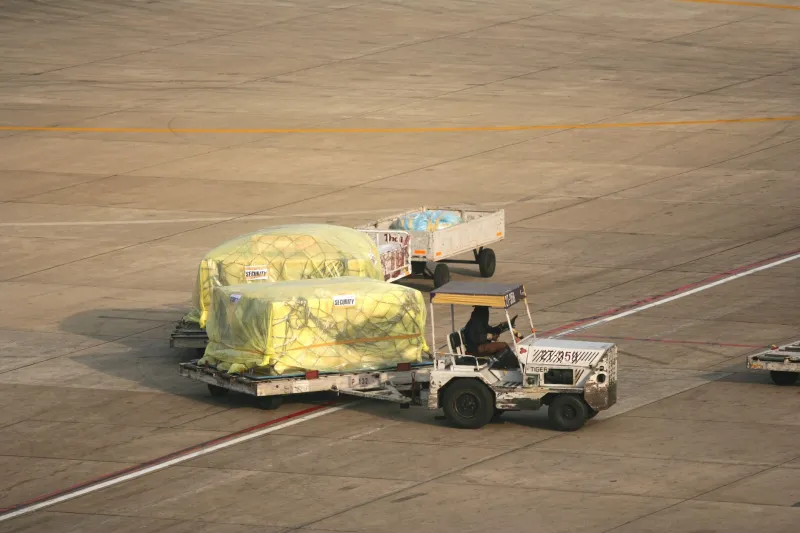
The actual crossing from Japan to the United States is where the logistics get genuinely impressive. Premium Nagasaki seafood moves by air — typically through major hubs like Tokyo Narita or Osaka Kansai — on cargo-prioritized routes that connect to LAX, JFK, SFO, and ORD.
The flights themselves are the easy part. What matters is how the fish is packaged for the journey. Export-grade Japanese seafood travels in purpose-designed insulated containers that maintain temperature within a one-to-two degree Celsius band for up to 40 hours without active refrigeration. The packaging uses a combination of phase-change materials (essentially high-performance gel packs that absorb heat at a specific temperature threshold) and vacuum-formed insulation that dramatically outperforms standard styrofoam coolers.
Flight time from Japan to the US West Coast runs roughly ten to twelve hours. Add pre-flight handling and post-landing customs clearance — which, for pre-cleared shipments from established Japanese exporters, can move in as little as two to three hours — and the fish is typically in a US distributor's refrigerated facility within 20 to 24 hours of leaving Japan.
For context: a fish caught off the US Atlantic coast and shipped to a Midwest grocery store via conventional refrigerated trucking can easily take 72 to 96 hours to reach the display case, with multiple temperature-inconsistent handling events along the way.
The Last Mile: What Happens in the US
The cold chain's final leg is often where things either hold together or fall apart. Premium Japanese seafood distributors operating in the US — the companies that supply serious Japanese restaurants and high-end fish markets — typically maintain their own temperature-controlled delivery fleets rather than relying on third-party logistics. The obsession with temperature continuity that governs the Japan side of the supply chain doesn't stop at the port of entry.
For consumers buying directly from Japanese seafood importers online (a growing market in the US, particularly post-pandemic), the last-mile packaging is similarly engineered. Overnight delivery with insulated packaging that maintains safe temperatures for 24 to 36 hours is standard for reputable importers. The fish often arrives in better condition than what's been sitting in your grocery store's display case since Tuesday.
How to Use This Knowledge When You Buy
Understanding the supply chain gives you concrete tools for evaluating what you're buying and how to handle it once it's home.
Ask for catch date documentation. Reputable Japanese seafood importers and distributors maintain catch-date records. If a vendor can't tell you when the fish was caught — not when it was delivered, but when it came out of the water — that's information worth noting.
Understand that "fresh" is a supply chain claim, not just a sensory one. Fish that looks fine and smells clean can still be further along its quality arc than you'd want. Japanese-sourced fish with documented handling history gives you a verifiable quality story that appearance alone can't provide.
Treat your home refrigerator as part of the cold chain. The precision that governs Nagasaki seafood from boat to distributor can be undone in an afternoon if you leave the fish in a warm car or store it at the wrong temperature. Keep purchased fish as cold as possible without freezing — ideally packed in ice in your refrigerator — and plan to cook it the day you buy it or the day after.
Know what you're paying for. The premium on high-quality imported Japanese seafood reflects real infrastructure costs: the ikejime processing, the temperature-controlled logistics, the documentation, the air freight. When you understand what went into getting that fish to your kitchen in peak condition, the price makes a different kind of sense.
Freshness Isn't Geography — It's Systems
The lesson from Nagasaki's supply chain isn't that Japanese fish is inherently superior to American fish. It's that freshness is an engineered outcome, not a default one. It requires intentional handling at every step, and it requires treating every hour and every degree of temperature change as consequential.
The US domestic seafood industry is improving on this front — there are American fishermen and distributors doing genuinely impressive cold chain work. But the standard that Nagasaki's export infrastructure has set is a useful benchmark for understanding what's possible when the entire supply chain is built around one goal: getting the fish to you exactly as the ocean intended it.